Add people where people make the difference.
Hire for expertise, customer relationships, and work that needs good judgment. Give those people the time and tools to do what you hired them for.
Custom software for small businesses
fewer tabs. fewer “who owns this?” messages.
Custom software, client portals, and AI automation. Built around the way you work, so your next stage of growth feels a whole lot easier.
Free 30-minute call with Neil · No preparation needed
Built by Neil · Explore the product
yes, this one actually exists
Orbit is a product I designed and built. Explore the contacts, pipeline, inbox, and calendar in the live demo to get a feel for my work. We’ll shape your app around the workflow that matters most to your business.
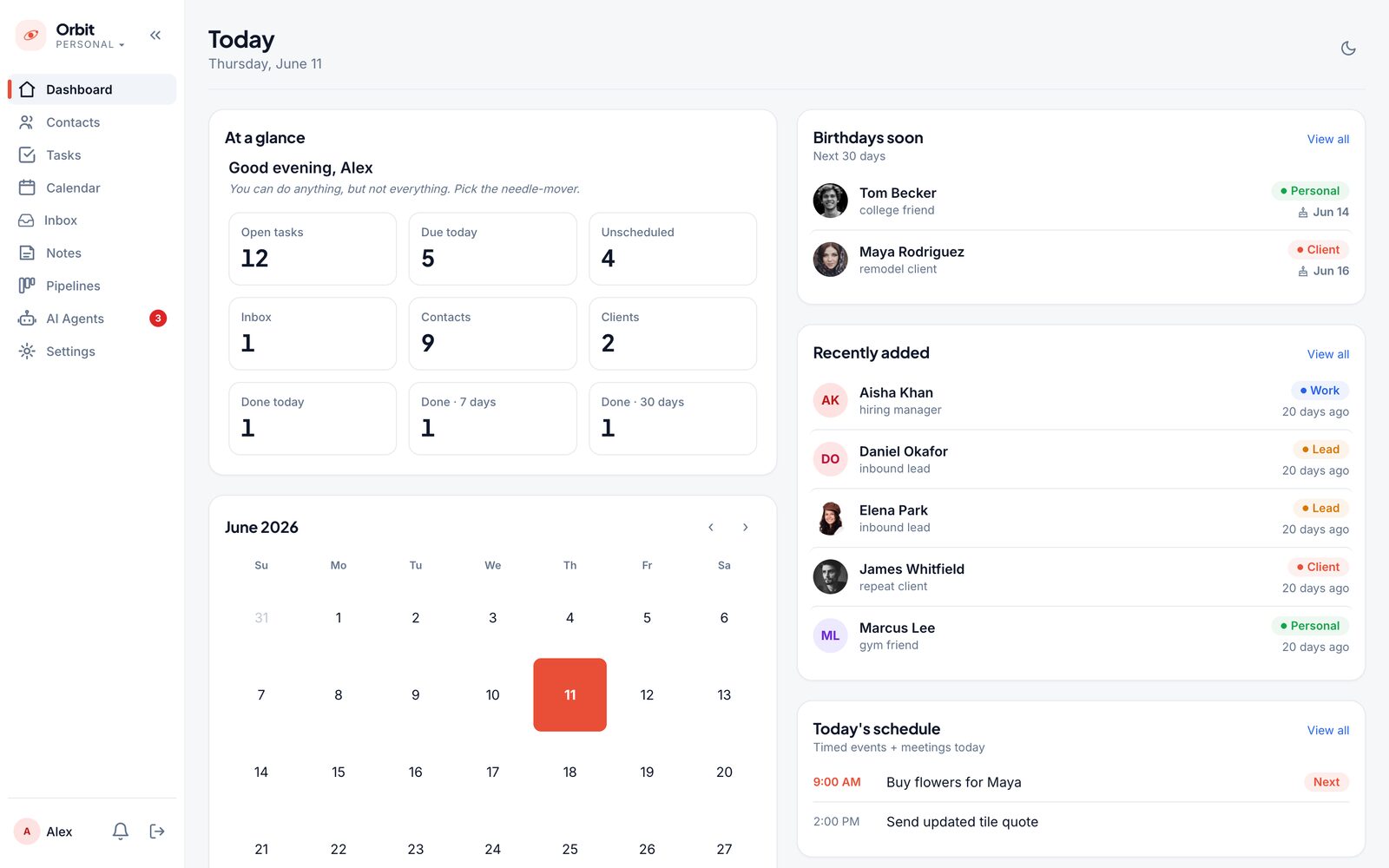
The whole operation, visible at a glance.
Product · design · engineering · launchBuilt for growth
growth without another heroic spreadsheet
When demand grows, hiring is one way to add capacity. Another is to build software that takes repetitive work off your team’s plate. The right combination helps you grow while keeping the cost of delivering each job under control.
Hire for expertise, customer relationships, and work that needs good judgment. Give those people the time and tools to do what you hired them for.
Let software collect client information, move jobs forward, prepare reports, and flag missing steps. Give every new client a clear process your team can manage.
That’s the goal: take on more work and keep more of what you earn. We start with one process and measure the admin hours it saves, the cost per job, and the extra work your team can actually handle.
See how to work out the returnWhat I build
start with the part everyone quietly groans about
Start with the work that gets harder as you grow: following up with leads, onboarding clients, tracking jobs, or pulling reports. Build a system that makes the next client easier to take on.
Turn jobs, owners, handoffs, approvals, and exceptions into one clear operating flow.
Give customers one calm place for requests, files, messages, approvals, payments, and status.
Research, triage, draft, monitor, and recommend inside the workflow—with permissions and human review.
Keep the tools worth keeping while records, next steps, and updates move reliably between them.
Answer questions about margin, capacity, pipeline, delivery, and risk from operational data.
Put the right answer beside the work so quality does not depend on one person remembering everything.
Examples
These are examples of what we could build together. Choose a recurring process where a clearer system would make a difference to your team or your customers.
Capture, qualify, route, and follow up while the opportunity is still warm.
Collect forms, files, decisions, payments, and progress without the email chase.
Match people, locations, capacity, and priorities without rebuilding the plan.
Move requests from intake to estimate, decision, signature, and delivery handoff.
See every active job, blocker, promise, owner, and next action in one place.
Watch for missing steps, prepare context, and surface the work that needs a person.
AI agents
helpful robot. short leash.
An agent can gather context for a new inquiry, prepare a reply, or flag a missing step. I build it into your workflow with clear permissions, review points, and an activity history, so your team can check the work and stay in control.
Replace manual intake and appointment follow-up across three locations.
Context gathered3 locations · 22 staff · multi-location intake
DoneInquiry qualifiedStrong workflow fit · meaningful admin burden
DonePersonal reply draftedUses inquiry, company context, and approved rules
ReviewFor founders and vibe coders
You’ve tried building with AI. The idea is on screen, the demo looks promising, and now you’re stuck on the part another prompt won’t quite fix. I can help turn that head start into software people can use.
Show me the app, the code, and where things get stuck. We’ll review what works, what is fragile, and what needs to change before you put real customers through it.
Sign-in, permissions, saved data, integrations, and the steps that fail halfway through. We’ll define a complete workflow, test it, and prepare the app for launch.
Some apps need a focused fix. Others need a deeper rebuild. We agree on the scope and timeline after reviewing what you have.
Talk through your unfinished app
Your builderNeil BusqueElizabeth, New Jersey · Available worldwide
A personal build should feel personal
I’m Neil. I like getting into the details of how a business works and turning them into software that feels natural to use. We make the important decisions together, and I handle the design, build, testing, and launch. When you have a question, you can ask me directly.
Let’s talk about your projectHow it works
weekly progress. zero dramatic reveal.
We work through a focused build together over four weeks. You try working software early, give feedback each week, and see how the decisions take shape.
Show me how the work happens today, including the steps that only make sense once you explain them. We agree on a focused first outcome.
Click through the product while the important decisions are still easy to change.
Finish roles, data, integrations, agents, reporting, and the edge cases that matter.
Verify the system, train the team, and put the code, data, accounts, and documentation in your hands.
The agreed core workflow includes launch, handoff, and 30 days of stabilization. If it is not usable by day 30, I keep working on the original scope at no added build fee. Kickoff requirements and exclusions apply.
See the complete offerResources
free. useful. no email hostage situation.
Practical guides for mapping workflows, evaluating custom software, and putting AI agents to work responsibly.
Answer five practical questions and get a tailored opportunity brief in about three minutes.
A practical framework for choosing whether to buy, connect, or build.
See what changes the price and how to compare quotes by the working outcome.
Turn the real process—including decisions and exceptions—into a build-ready map.
Map the path from signed agreement to a client and team that are ready to begin.
Concrete jobs for lead response, inboxes, delivery, knowledge, and reporting.
Plain answers
Yes. We start by reviewing the existing app, code, and workflow to identify what can stay and what needs work. That may mean fixing a specific issue, finishing integrations and permissions, or rebuilding a fragile part. The scope and timeline are agreed after that review; an existing app does not automatically fit the 30-day build.
Pricing depends on the workflow, integrations, and scope. After a free call, you receive a clear proposal before committing. It includes the agreed core workflow, launch, training, documentation, and 30 days of stabilization. Hosting, third-party services, and future features are separate. Scope and ongoing costs are agreed before work begins.
When a repeated workflow creates enough manual effort, delay, risk, or customer friction that configuring another generic tool will not solve the underlying problem. The first call is partly for deciding whether a build is actually the right move.
A focused operations app, client portal, internal CRM, scheduling or quoting tool, reporting system, or AI-enabled workflow with a clear first boundary. It is one complete, usable system—not every future feature.
Agents can research, classify, summarize, monitor, draft, and recommend. Sensitive actions stay behind explicit permissions, human approval, and an activity log.
Usually. Reliable specialist tools can stay connected when they have a supported integration path. We decide what remains, what becomes the source of truth, and what should stop creating duplicate work.
You do. The code, data, database, design, accounts, and documentation are set up in your name and handed over. There is no required retainer or proprietary platform lock-in.
Make room for your next stage of growth
Crumpled notes welcome.
Tell me what you want to grow and what is taking up your team’s time. We’ll find a practical place to use software, free up capacity, and work out whether the build makes business sense.
Book a free workflow call Free 30-minute call · Direct with Neil · No obligation